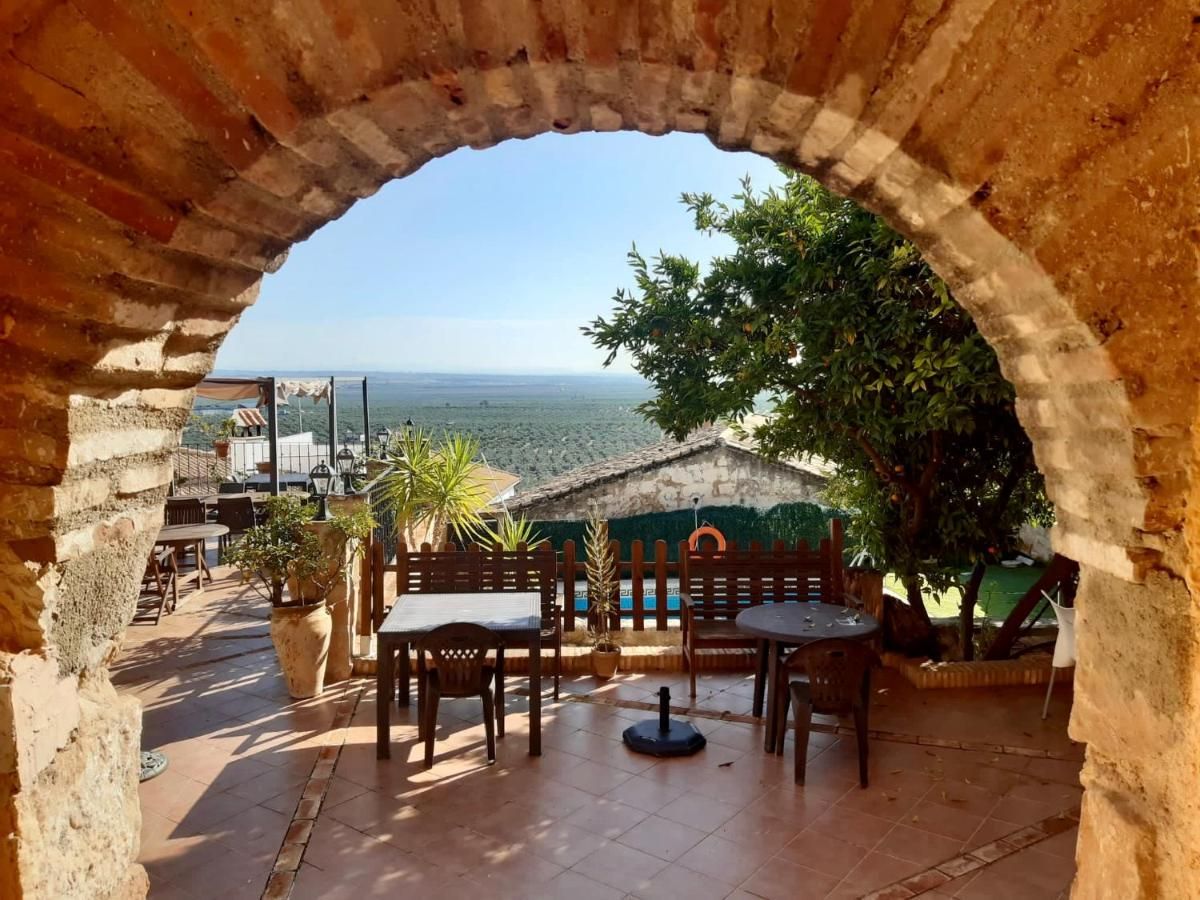
Baños de la Encina holds much of its history high above the streets. Burgalimar Castle follows a rocky ridge over the tiled roofs, giving this town in northern Jaén a striking outline against the foothills of Sierra Morena. Below, narrow lanes connect a Gothic church, old civic buildings and richly decorated religious interiors. Beyond the houses, the land falls towards the Rumblar reservoir, where an even earlier chapter of settlement survives.
Burgalimar Castle above the old town
The fortress known as Castillo de Burgalimar was completed in 968 under the caliph al-Hakam II. Its elongated walls follow the contours of the rock rather than a regular geometrical plan. Fourteen predominantly square towers strengthen the enclosure, while the taller keep belongs to changes made after the Christian conquest. Much of the original structure was built in tapial, layers of earth, lime, sand and small stones compacted within timber forms.
The castle is best understood alongside the streets beneath it. As the lanes rise towards the walls, the relationship between the fortification and its hilltop setting becomes clear. Baños de la Encina’s historic centre was designated a protected historic ensemble in 1969, and the houses below the ramparts preserve traces of the town’s later prosperity. Stone doorways, coats of arms and former noble residences offer a domestic counterpoint to the monumental fortress.
San Mateo and the Baroque surprise of Cristo del Llano
In the Plaza Mayor, the Iglesia de San Mateo brings several architectural periods into one building. Its main Gothic nave dates from the late fifteenth century; a later entrance, carved in 1576, and the octagonal tower of 1596 introduce Renaissance-era forms. Opposite, the Casa Consistorial recalls the reign of Charles I, placing civic and religious life around the same square.
Nearby, the town’s historic houses tell a quieter story of families and local authority. Buildings such as the Palacio de los Molina de la Cerda and Palacio de Priores belong to the heritage of a settlement whose importance extended beyond the castle. Their presence makes the old centre more than a route between a handful of major monuments.
The Ermita del Cristo del Llano offers perhaps the sharpest contrast of all. Its exterior is relatively restrained, but inside is an exuberant eighteenth-century devotional chamber. Painted plasterwork, sculptural ornament and mirrors surround the space, creating a very different experience from the plain strength of Burgalimar’s walls. Together, these buildings show how the town’s architecture moved from defence to civic display and elaborate religious expression.
Peñalosa and the landscape of the Rumblar
The area’s history reaches far beyond the medieval castle. At Peñalosa, beside the Rumblar reservoir, archaeologists have investigated a Bronze Age settlement of the El Argar culture. It occupied a slate spur above the waterways, with terraced structures and evidence of copper mining and metalworking. The site reveals a community whose working life depended on the resources of the surrounding hills, long before the present town took shape.
Part of the wider municipality lies within the Sierra de Andújar Natural Park, where holm oak, cork oak and stone pine are part of the Mediterranean woodland. This landscape gives a different perspective on Baños de la Encina from the closely built streets. The castle, church, Baroque chapel and archaeological remains are distinct chapters in a place shaped for centuries by its position between the sierra and the valley.