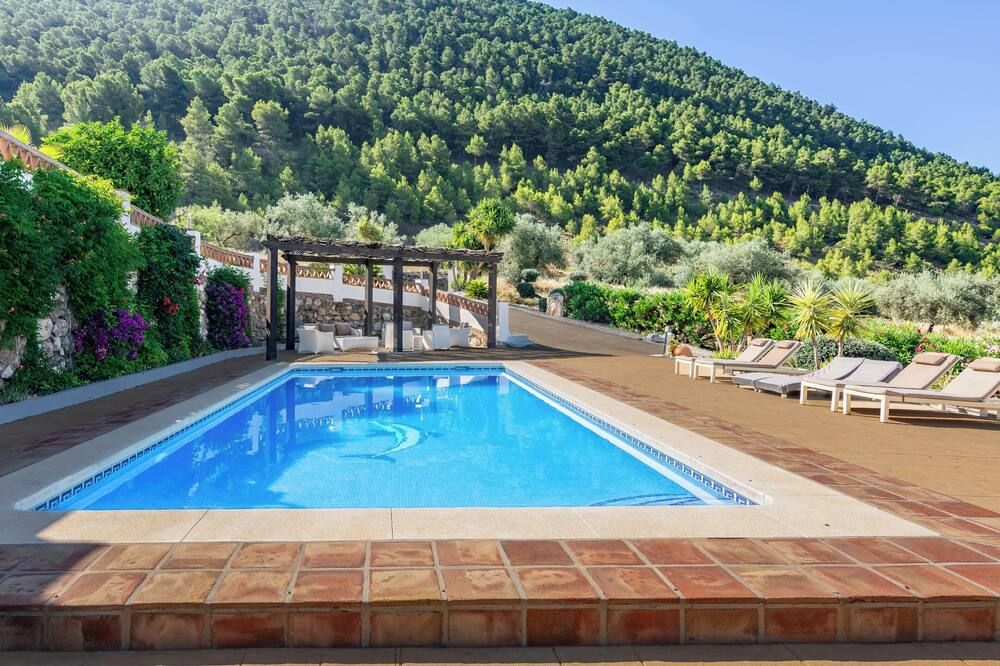
Casa Arts, Alcaucín
Casa Arts pairs a view-facing outdoor pool and garden with a restaurant, bar and coffee shop in Alcaucín. Family facilities, bike hire, activity options and parking help define the practical shape of…
Read hotel guideThe art of finding somewhere wonderful.
Video by Nirjhar Basak on Pexels
Alcaucín’s recorded heritage reaches beyond the village streets to places where the landscape itself shaped human history. Two striking examples are the remains of Castillo de Zalia and the archaeological evidence preserved in Cueva del Boquete de Zafarraya. Together, they give the municipality a story that stretches from a strategically placed medieval fortress to traces of prehistoric life.
Castillo de Zalia occupied a strategic position on the historic Nasrid royal road linking Granada with the Axarquía coast through the Zafarraya pass. Its irregular plan follows the contours of the ground, and the surviving remains still suggest the scale and complexity of the stronghold. The enclosure extended roughly 120 metres from east to west and 150 metres from north to south.
Rather than a single wall, the castle had two uneven defensive enclosures. Parts of the outer walls remain, with square and rounded towers interrupting their masonry; sections have disappeared or shifted. Within, a more regular enclosure contains a square cistern and an imposing entrance flanked by two large masonry towers, finished higher up in rammed earth. The surviving fabric makes the site legible as both a defensive structure and a carefully adapted work of architecture.
On the southern slope of the Sierra de Alhama, at an altitude of 1,100 metres, Cueva del Boquete de Zafarraya opens in a vertical limestone cliff. The cave descends 33 metres and divides into two passages: one drops vertically, while the other forms a gallery with archaeological deposits.
Excavations have brought to light material from the Late Neolithic or Eneolithic, as well as a distinctive Mousterian stone-tool industry. Palaeontological bone remains were also found, some apparently modified into tools. Most notably, the cave has yielded remains identified as Neanderthal. This evidence gives the site significance far beyond its dramatic setting: it preserves traces of human presence across very different periods.
These places offer two complementary ways to understand Alcaucín. At Zalia, the strategic logic of a fortified route is still visible in the walls, towers and cistern. At Boquete de Zafarraya, the story reaches much further back, into the deep record of human occupation. The municipality’s heritage is therefore not confined to a single monument or era; it is written into both its built remains and its surrounding terrain.
Casa Arts pairs a view-facing outdoor pool and garden with a restaurant, bar and coffee shop in Alcaucín. Family facilities, bike hire, activity options and parking help define the practical shape of…
Read hotel guide