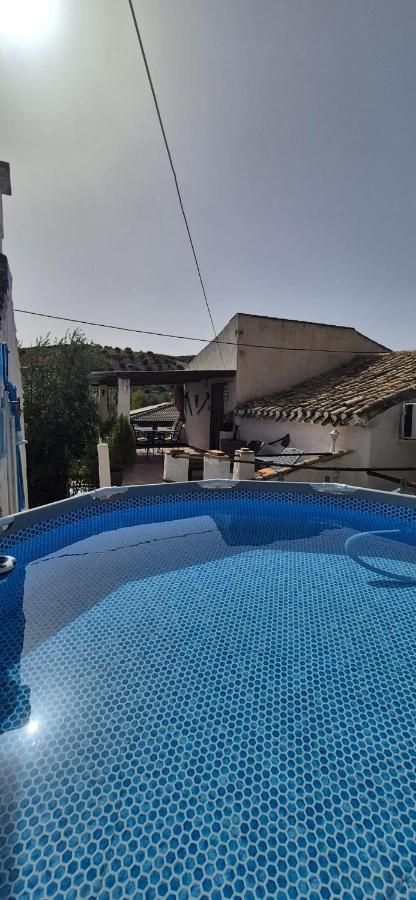
Casa Rosa, Almedinilla
Casa Rosa pairs an outdoor pool and plunge pool with garden and mountain views in Almedinilla. Free parking, air conditioning and practical provisions for families make it a flexible base in Andalucía’s…
Read hotel guideThe art of finding somewhere wonderful.
Video by Nirjhar Basak on Pexels
Almedinilla’s heritage is unusually legible in the structures people made to live, work and mark their place in the landscape. The story reaches from an Iberian settlement cut into a limestone hillside to the machinery of an old mill, while churches and public fountains preserve quieter details of communal life. Together, these places offer a grounded way to encounter the town’s past without reducing it to a single period.
At Cerro de la Cruz, the terrain is part of the archaeology. The site occupies a limestone fold in the Subbética landscape, on a slope overlooking Almedinilla from the south-west. Its Iberian settlement was laid out in stepped terraces excavated directly into the rock, with substantial retaining walls supporting streets and working and living spaces. The recorded remains include a carefully organised combination of storage, grinding areas, looms and cisterns; house walls of stone foundations and adobe or rammed earth survive in places to considerable height.
This was not simply a cluster of homes on a hill. Its planned arrangement shows how inhabitants adapted a steep site for everyday life. Excavation evidence also records a violent destruction by fire towards the end of the second century, followed by abandonment. The resulting archaeological story is compelling precisely because it joins the broad outline of a settlement to the practical details of its rooms and work areas.
The Museo Histórico de Almedinilla brings together several strands of local history in a former mill complex. The old oil mill’s exterior remains, and its machinery is retained as part of the museum; the stone flour mill is especially notable for its water channel and surviving machinery. Its collections include Iberian objects from Cerro de la Cruz, Roman everyday artefacts and coins, and sculpture associated with a Roman villa, including a figure identified as Hypnos or Somnus. A further section interprets the flour mills once driven by the Caicena River.
The present parish church of San Juan Bautista is a more recent building, inaugurated in 1978 after its predecessor was demolished in the 1970s. In its atrium, a stone bell gable from the earlier church, built in 1769, survives as a humilladero. Inside, the recorded works include a life-size seventeenth-century crucifix, a carved Saint John the Baptist associated with Alonso de Mena’s workshop around 1630, and an eighteenth-century Nazarene image linked to the circle of José de Mora. These details give the church a layered history that extends beyond its modern exterior.
Almedinilla’s fountains and water points make a smaller-scale counterpoint to its archaeological and museum collections. The Pilar del Puente, beside a bridge on the old Priego–Alcalá route, served both the population’s water needs and as a trough for animals. The Fuente del León, with a carved lion’s head above its basin, has a more decorative character. Such modest structures reward attention: they show how water, passage and shared public space have been woven into the town’s material history.
From the terraces of Cerro de la Cruz to the channels and machinery of the mills, Almedinilla’s most distinctive stories are rooted in adaptation: to a hillside, to water and to the practical needs of successive communities.
Casa Rosa pairs an outdoor pool and plunge pool with garden and mountain views in Almedinilla. Free parking, air conditioning and practical provisions for families make it a flexible base in Andalucía’s…
Read hotel guide