Arcos de la Frontera is shaped by a striking meeting of town and terrain. Its historic centre occupies the heights and slopes of rocky outcrops beside the River Guadalete, within a broad meander. From the river’s edge to the base of the castle, the recorded rise is more than 140 metres; steep escarpments define parts of the northern and south-western sides. The old town follows this uneven ground in an elongated form, its irregular streets narrow and often sharply inclined.
That topography is part of the pleasure of exploring Arcos, but it also explains its distinctive urban fabric. Lanes twist between irregular blocks, while the historic core’s changing levels reveal how closely the settlement has adapted to the rock. The old walls, with surviving sections around the south-eastern Puerta de Matrera, give this layered landscape a longer history: the medieval town grew over the Andalusian settlement of Arkûs, whose fortifications date in part to the 11th and 12th centuries.
Walls, castle and older layers
The Alcázar stands within the urban centre, its present form reflecting substantial changes in the 14th and 15th centuries. A horseshoe arch at the old western entrance and a stretch of wall to the south-west are identified as remains of the earlier fortress. The surviving urban wall is especially notable around the Puerta de Matrera; other traces have been incorporated into later buildings. Arcos is therefore not a place where history sits apart from everyday streets: successive phases of the town are bound into its fabric.
Beyond the fortifications, the churches reveal another sequence of building and artistic change. Santa María de la Asunción combines a late-Gothic interior, with star-patterned rib vaults, and a Renaissance vault over its main chapel. Its tower and Baroque entrance belong to a later chapter. San Pedro likewise retains a 16th-century Gothic core, enriched over time by Renaissance and Baroque chapels and an 18th-century Baroque façade. These buildings reward attention to detail, from the structure of their vaults to the way later work reshaped older foundations.
Courtyards and changing styles
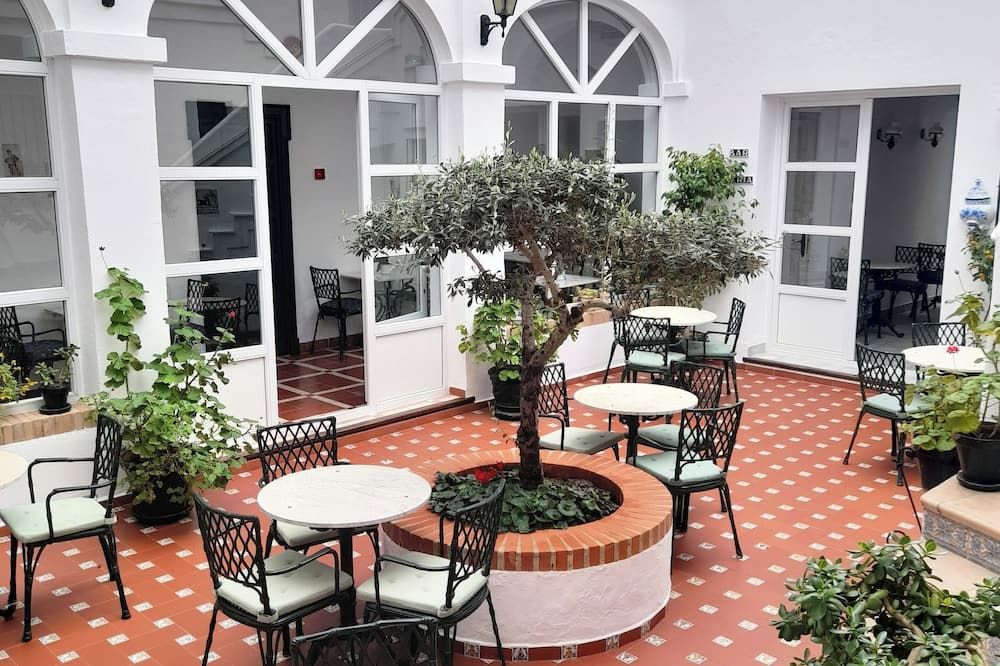
Civic and religious buildings add further contrasts. The 17th-century Palacio del Mayorazgo del Prado is arranged around two courtyards, with Tuscan columns, arcades and a distinctive upper-level viewing gallery. The Convent of the Mercedarias, founded in 1650, also turns inward to a pair of courtyards. Nearby heritage records describe buildings in which Mudéjar traditions sit alongside Baroque or later decoration, a reminder that Arcos’s character is made from layers rather than a single architectural moment.
Follow the bends and rises of the old streets with time to notice those transitions: a fragment of wall, a church portal, a courtyard façade, and then the broad presence of the Guadalete below. In Arcos, the town’s history is most compelling where its architecture and steep setting meet.