Casares is a municipality of sharply contrasting settings: its historic centre climbs a steep hillside among the southern foothills of the Serranía de Ronda, while its territory reaches the Mediterranean coast. That variety is visible in the places it has preserved, from a tightly shaped hilltop settlement to waterworks, rural buildings and a coastal watchtower.
A village fitted to the hillside
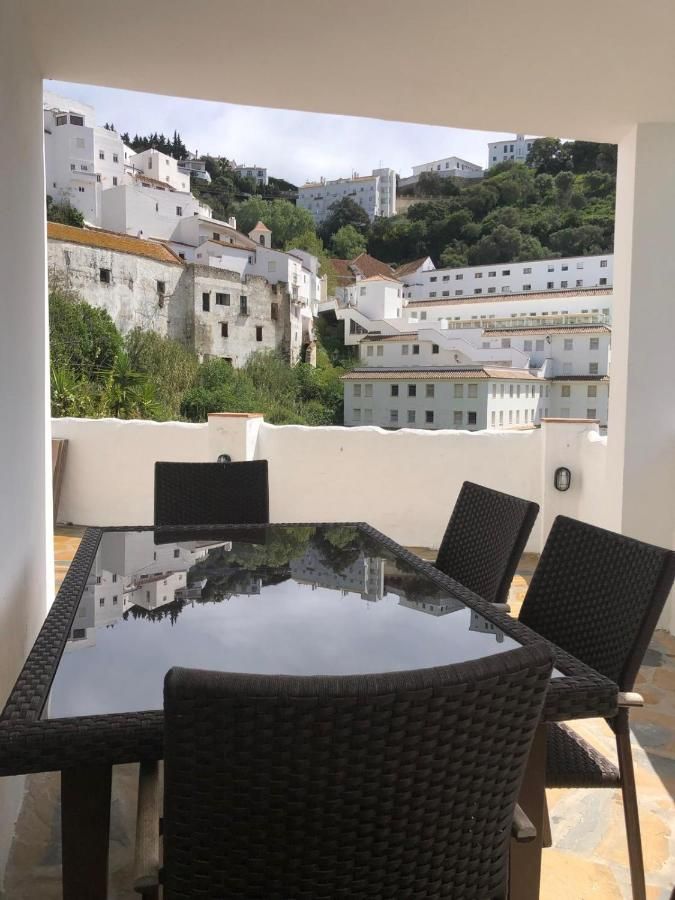
The old centre occupies rocky ground on the slopes of Sierra Crestellina, between the Hortezuela and Albarrán streams. Its upper edge is marked by the castle and church; below, the houses follow the terrain into the hollows. Streets run broadly along the contours, bending around the steep ground in a pattern described as Hispano-Muslim and defensive in character. The result is not a regular grid but a close-knit arrangement of lanes, turns and small passages, with buildings rising in response to the changes in level.
The castle enclosure crowns the settlement. Its surviving remains include an arched entrance, defensive towers and sections of wall, set against a rocky outcrop that provided a natural barrier to the south and south-west. Inside the enclosure stands the Church of the Incarnation. Nearby, the Fuente de Carlos III offers a different glimpse of the town’s history: completed in 1785, it formed part of an eighteenth-century project to bring spring water from the Puerto de las Viñas to the centre. The neoclassical fountain retains its original arrangement of stonework and four outlets.
Water, worship and the wider municipality
Casares’s heritage extends beyond its steep centre. The Baños de la Hedionda are sulphurous-water baths in a square, vaulted structure beside the Albarrán stream. Close by, the sixteenth-century Bridge of the Baths, restored in the eighteenth century, served both as a crossing and as an aqueduct for an irrigation channel. Together, they show how water shaped practical structures as well as places of use.
Religious buildings connect the village with the surrounding landscape. The small seventeenth-century Ermita de San Sebastián stands in Plaza de España and houses the image of Nuestra Señora del Rosario del Campo. In May, the image is taken to the Ermita del Rosario, between the Genal and Guadiaro rivers, for the annual romería. The countryside also preserves evidence of working life: Casa de la Tenería is a rural building whose name suggests a possible association with leather-tanning, while the remains of the Molino de la Acedía record the use of local water to mill grain.
At the coast, Torre Salto de la Mora occupies a rocky headland between the Manilva river and Arroyo Camarate. Known from at least the sixteenth century, this square, two-storey masonry tower formed part of the coastal watch system. Its position makes a striking counterpoint to the inward-looking lanes of the old centre: Casares is defined not by one landmark, but by the varied terrain and histories gathered across its municipality.