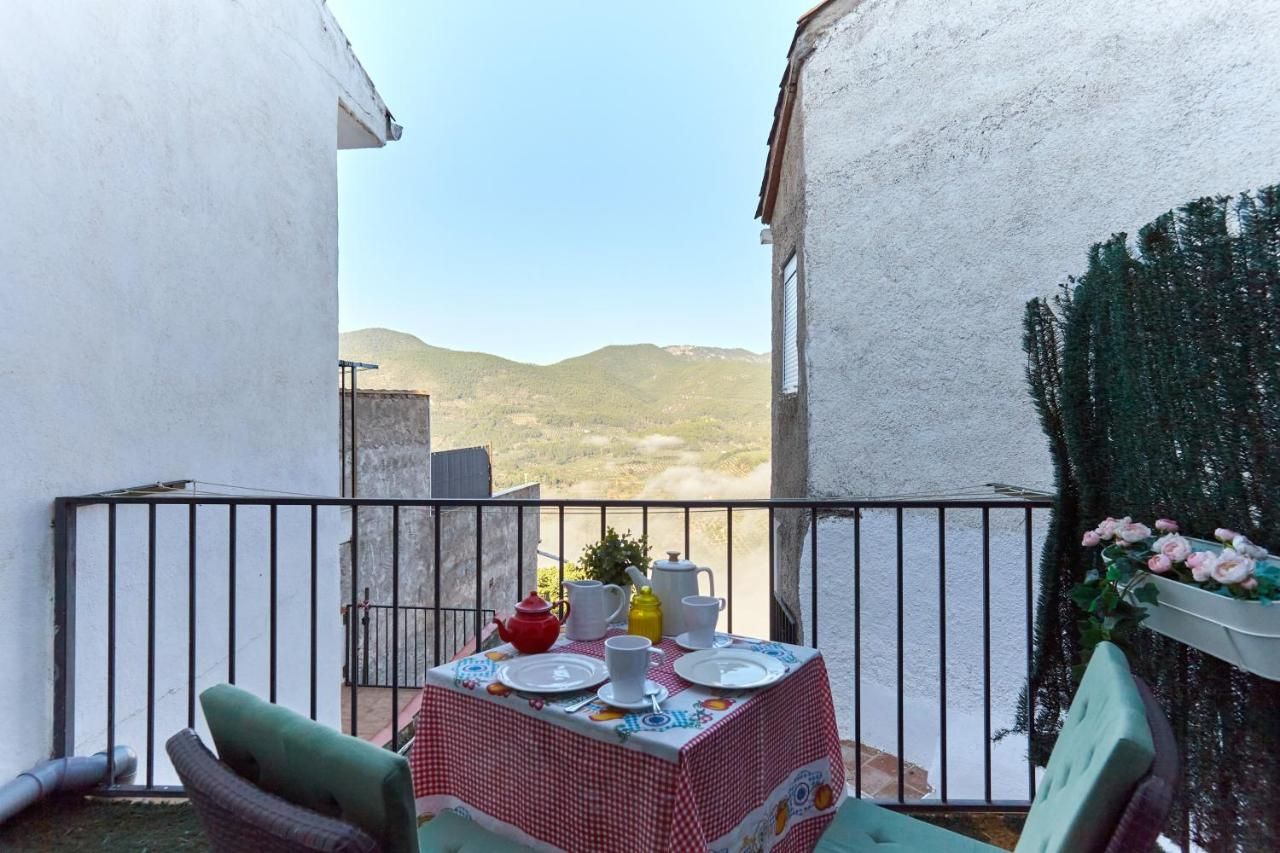
Hornos rises from a rocky promontory above the Tranco de Beas reservoir, its compact old centre following the contours of the ground. The village’s position is more than a dramatic backdrop: steep slopes shape its outline, while the narrow, irregular streets and small dead ends reflect the limits imposed by the ridge. From the settlement, the landscape opens towards the broad valley between the Sierras de Segura and Las Villas, where the Hornos river runs towards the reservoir.
A village shaped by the ridge
The historic centre gathers around the high ground, with the castle and remains of the walled enclosure crowning the rocky rise. Below them, the settlement developed in a close, roughly oval form. Its lanes bend and narrow with the terrain rather than following a regular grid; the old fabric remains particularly constrained by escarpments and the surviving line of the enclosure. This compact arrangement gives Hornos a distinctive profile: white buildings clustered against stone, with the castle occupying the summit.
The Puerta de la Villa offers a glimpse of the defences that once controlled entry to the settlement. Set within a substantial stone tower, its passage turns inward rather than running straight through. The paired pointed arches and the tower’s upper level speak to a defensive design in which access could be restricted. The gateway was restored in 1973, when work also reinstated its vaulted structure.
Castle, church and deeper history
At the top, the castle’s surviving enclosure is slightly trapezoidal, with a prominent square keep and the remains of smaller towers. Built of masonry, the keep stands on a rocky base that contains a cistern; its entrance is raised above ground level. The setting is inseparable from the monument: the castle occupies the small height at the centre of the promontory, above the village and the reservoir-facing slopes.
Near the historic centre, the parish church of Nuestra Señora de la Asunción brings a different architectural note. Its tower, with a belfry of four round-arched openings, is crowned by a late Gothic cresting and corner gargoyles. The richly ornamented entrance uses early Renaissance forms, making a striking contrast with the tower’s Gothic details.
Hornos’s story reaches further back than its medieval defences. Archaeological study of the promontory recorded occupation from the third to the middle of the second millennium BC, when a settlement stood on this elevated site. That long human presence lends added meaning to the village’s relationship with the ridge: its commanding position has shaped both its buildings and its history.
In Hornos, the most rewarding perspective is the connection between those elements. The castle, gateway and church belong to a village whose form is inseparable from the rock beneath it and the valley beyond. Together they make this small settlement a particularly legible meeting of landscape, architecture and time.