Huelva is a city shaped by water, uneven ground and a long record of settlement. Its setting in the estuary where the Tinto and Odiel meet gives the place a character distinct from the better-known seaside towns of Andalucía: here, river mouths and port history sit alongside a dense urban landscape of hills, churches and civic buildings.
The city’s archaeological story reaches far back. Evidence from the Cabezo de San Pedro points to occupation extending from the beginnings of the Bronze Age into later periods, while excavations across the wider archaeological zone trace settlement from the Copper Age onwards. In the seventh and sixth centuries BC, Huelva developed as an important trading centre; stone-built rooms and evidence of storage suggest a town expanding down from the higher ground towards lower slopes. The archaeological record is not a single monument but a history encountered in different parts of the city.
Hills, churches and layers of architecture
The cabezos, or urban hills, remain part of Huelva’s physical character. Cabezo de San Pedro has steep slopes on three sides and a gentler eastern approach, a landform whose present profile reflects both erosion and generations of building. The city’s religious architecture offers another way to read its past. The Church of San Pedro, set on a raised platform, is a brick-built Mudéjar church with three naves and pointed arches. At the Santuario de Nuestra Señora de la Cinta, on the Conquero, a fifteenth-century Mudéjar design is expressed through a three-aisled interior and a courtyard approach.
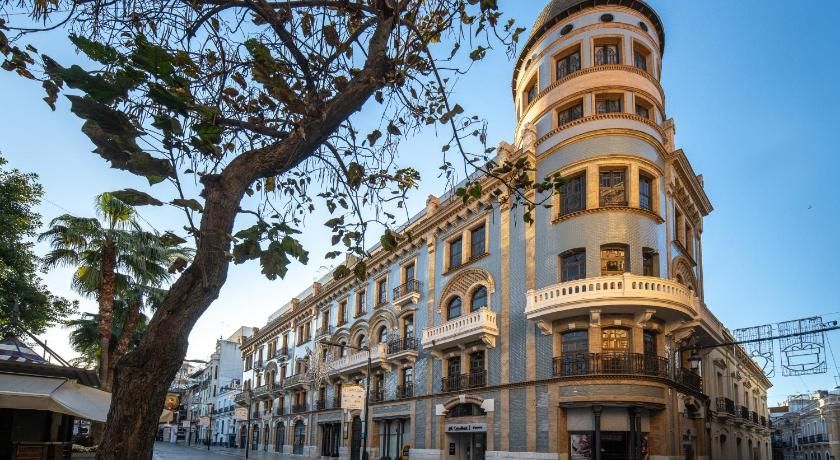
Other buildings tell a more recent story. Casa Colón began as a group of four large buildings arranged around a garden; some parts of the original ensemble have since disappeared. The former Estación de Sevilla, completed in 1880, combines brickwork with horseshoe arches and a doorway framed in an Almohad-inspired style. In the twentieth century, the Cine Rábida brought a strikingly different vocabulary to the historic centre: its 1931–33 design by Luis Gutiérrez Soto is marked by a curved corner, a projecting entrance canopy and round windows.
Between the estuary and the port
Huelva’s connection with the rivers is also a story of industry and engineering. The surviving Tharsis Company loading pier stands on the right bank of the Odiel, near the municipal boundary. Built as part of the late nineteenth-century works that carried minerals from the mining basin, it extends for about a kilometre. Its railway approach and broad loading platform preserve the scale of that transport system in the landscape.
For a closer view of the city’s material past, the Museum of Huelva brings archaeology and fine art together in a modern, rationalist building between the old centre and Isla Chica. From prehistoric occupation to port infrastructure, Huelva is best understood through these overlapping traces: a settlement formed around its hills and estuary, continually reshaped by trade, building and the movement of people and goods.