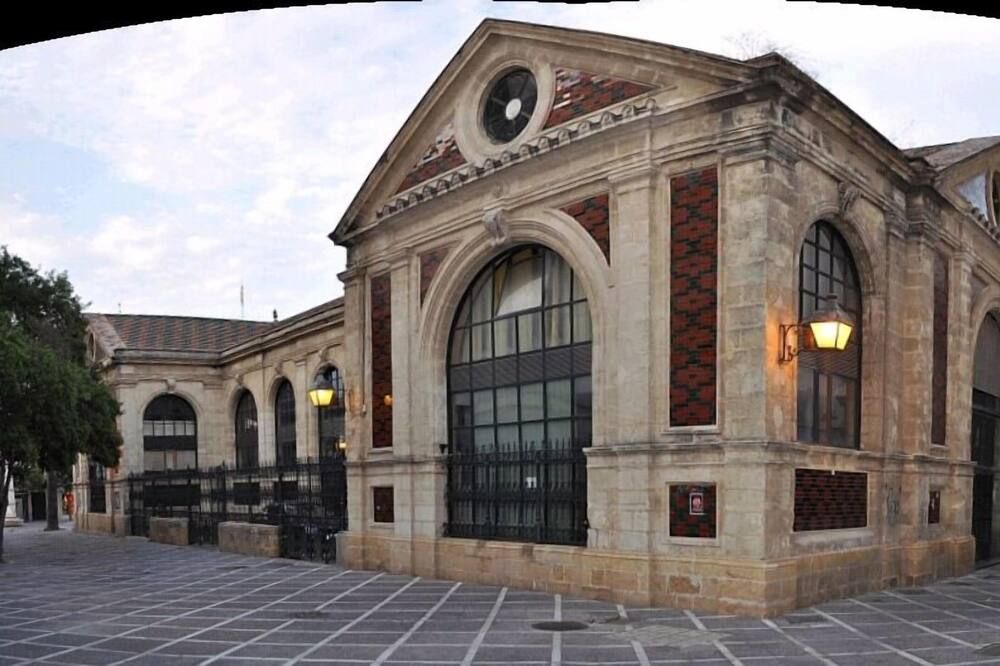
Jerez de la Frontera reveals its character through layers of architecture and the close relationship between its historic centre and the bodegas woven into the city. Churches, palaces and civic buildings tell different stories in stone, brick and ornament; the wine cellars, meanwhile, form a striking part of the urban fabric rather than a world apart from it.
Architecture across the centuries
At San Dionisio, a church built in the first half of the fifteenth century, Gothic-Mudéjar structure meets later Baroque alterations. Its three-naved basilical plan, pointed arches and intricate geometric decoration offer a particularly vivid expression of Jerez’s architectural inheritance. The nearby Church of San Juan de los Caballeros has a more layered construction history: its single nave contains work from different periods, while the Chapel of the Jura is distinguished by its star-patterned vault.
Elsewhere, the city’s historic buildings shift in style and scale. On Plaza del Mercado, Casa Riquelme was made for a prominent local family, its mid-sixteenth-century façade conceived as an imposing presence on the square. Its sculptural programme includes Hercules and a pair of figures with medieval roots. The Palace of Ponce de León offers another Renaissance thread: its courtyard combines Renaissance work with Gothic and Mudéjar details, while a finely composed Plateresque window dates to 1537.
A city shaped by wine
Near the Cathedral and Alcázar, the González Byass bodega complex occupies a substantial place within the historic city. Its interconnected cellars and paved internal streets give it something of the character of a town within the town. Bodegas Tío Pepe forms part of this larger ensemble, a reminder that Jerez’s wine-making heritage is also an architectural and urban story. Here, the productive buildings sit within the same cityscape as major monuments and long-established streets.
Jerez’s more recent architecture adds further contrasts. The railway station brings together historicist, Mudéjar and regionalist elements, with brick, stone, ironwork and tiles across its symmetrical façade. Teatro Villamarta, built between 1926 and 1928 to a design by Teodoro Anasagasti, presents a different early twentieth-century blend of styles.
What makes Jerez rewarding to explore is not a single monument or architectural period, but the way these different layers sit alongside one another. Its streets connect religious and domestic architecture, civic landmarks and the working scale of the bodegas, giving the city a distinctive sense of continuity between heritage and everyday urban life.