Lucena rewards attention to the layers held within its streets. Its historic centre brings together a fortified castle, churches of markedly different architectural character and the traces of a much older Jewish community. The result is not a single monumental story, but a town whose heritage moves between medieval foundations, early modern religious buildings and the ornamented confidence of the Baroque.
A castle at the heart of the town
The Castillo del Moral stands in the centre of Lucena, beside the church of San Mateo, Plaza de España and the municipal market. Its rectangular plan is guarded by four corner towers, including the octagonal Torre del Moral. A first enclosure is surrounded by a second, leaving a defensive passage between the walls; on the northern side, an Almohad pointed-arch doorway marks an older strand of the fortress’s history. The tower of the Homage is associated with Boabdil, the last Nasrid ruler of Granada, who was captured in 1483 at the battle of Martín González by Lucena’s regidor Martín Hurtado.
Close by, the Iglesia de San Mateo offers a different kind of encounter with the town’s past. Its high central nave and pointed arches make a striking interior, while the timber roofs and stone supports reveal the structure behind the church’s scale. Elsewhere, the former Hospital de San Juan de Dios is organised around a courtyard, with an elaborate entrance whose stonework, coloured marble and sculpted details reward a slower look.
Architecture shaped by devotion and craft
Lucena’s religious buildings are not variations on one theme. The Iglesia de Santiago Apóstol occupies a particularly layered place in local history: the heritage record identifies it as founded over an earlier synagogue, in a city described as one of Spain’s significant Sephardic centres before the expulsion of the Jewish population. Its basilican layout, late Gothic portal and later Baroque alterations give the building a complex architectural history as well as a profound association with the town’s Jewish past.
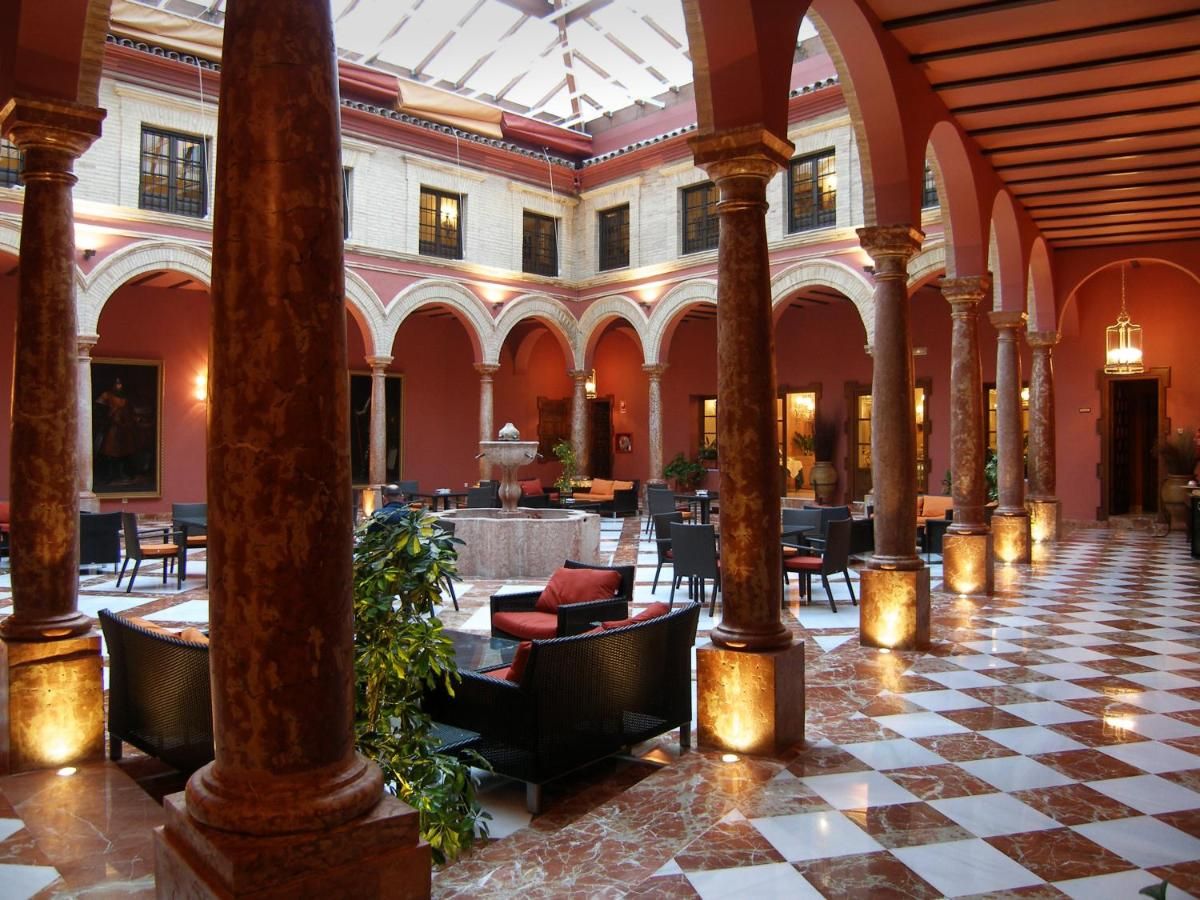
Baroque detail appears in several forms. At the Ermita de Dios Padre, exuberant plasterwork and painted decoration gather around the dome and sanctuary, set against a comparatively restrained façade. The Palacio de los Condes de Santa Ana makes its impression from the street, where a long façade culminates in a polychrome marble portal. Inside, a sequence of courtyards reveals contrasting materials and arcades. These are places to notice how decoration, structure and changing use have accumulated rather than to look for a uniform style.
Lucena’s heritage also extends beyond its grander buildings. The record of Alfarería Sartén documents a pottery workshop with wood-fired kilns, throwing rooms and spaces for making decorated ceramics, large storage jars and pitchers. It offers a glimpse of craft as part of the town’s built and working life, alongside the churches and palaces that more readily command attention.
From the castle’s defensive walls to the intimate geometry of a workshop, Lucena is best approached through such contrasts. Its centre holds successive histories close together, inviting a visit led by curiosity rather than a checklist.