Mijas is not a single coastal settlement but a municipality of three distinct centres: Las Lagunas and La Cala by the sea, and Mijas Pueblo on the southern slope of the Sierra de Mijas. That arrangement gives the place its defining contrast. The historic village sits above the coast, while the municipality also reaches the Mediterranean through its two shoreline centres.
A village above the coast
Mijas Pueblo’s position shaped its history. At 436 metres above sea level at the area around the castle and parish church, the old centre occupies a hillside with views over the nearby coast. Its elevated setting offered a vantage point over the shore and defensive advantages; the steep ground is especially marked south of the historic core, where the fortress once stood.
The village developed from at least the medieval period, with its origins and strategic importance associated in the heritage record with Roman and Andalusi periods. The surviving traces are modest but telling: part of the castle’s wall and a tower remain, while the internal structures have disappeared. Nearby, the Castillo-Ermita de la Virgen de la Peña brings together a rock-cut hermitage begun in the seventeenth century and a later chapel that holds the image of Mijas’s patron saint.
Reading the historic centre
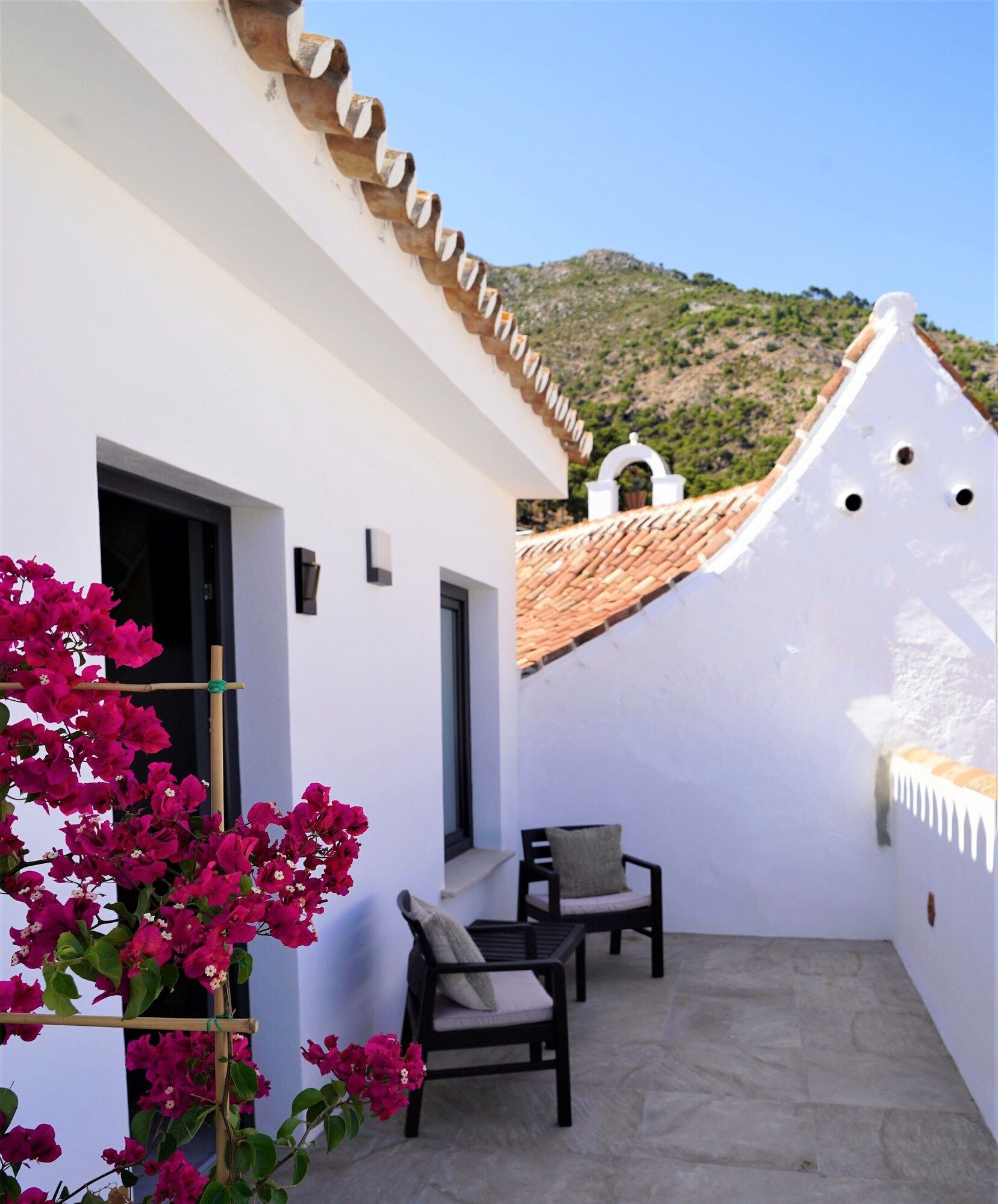
Rather than a level grid, the old settlement follows the slope. Its streets, elongated blocks and small squares developed in relation to the contours, with the more open ground of the former fortress area forming a focal point. Whitewashed buildings, flower-filled balconies and the mountain rising behind the village are part of the character recorded for this historic setting; from here, the view extends across the coast and, on clear days, towards the Strait of Gibraltar.
The municipality’s heritage is not confined to the hillside. The Ermita de San Antón, a simple single-nave building dating to the eighteenth century, is associated with the annual romería held on 17 January. In La Cala, the Church of Santa Teresa de Jesús represents a very different period: conceived in the 1970s for a growing coastal community, its unusual, folded form and indirect light reflect a modern approach to religious space.
To understand Mijas, look beyond the familiar image of the hilltop village. Its story is also one of a municipality linking mountain slope, historic settlement and Mediterranean shore, with each of its three centres contributing a different layer.