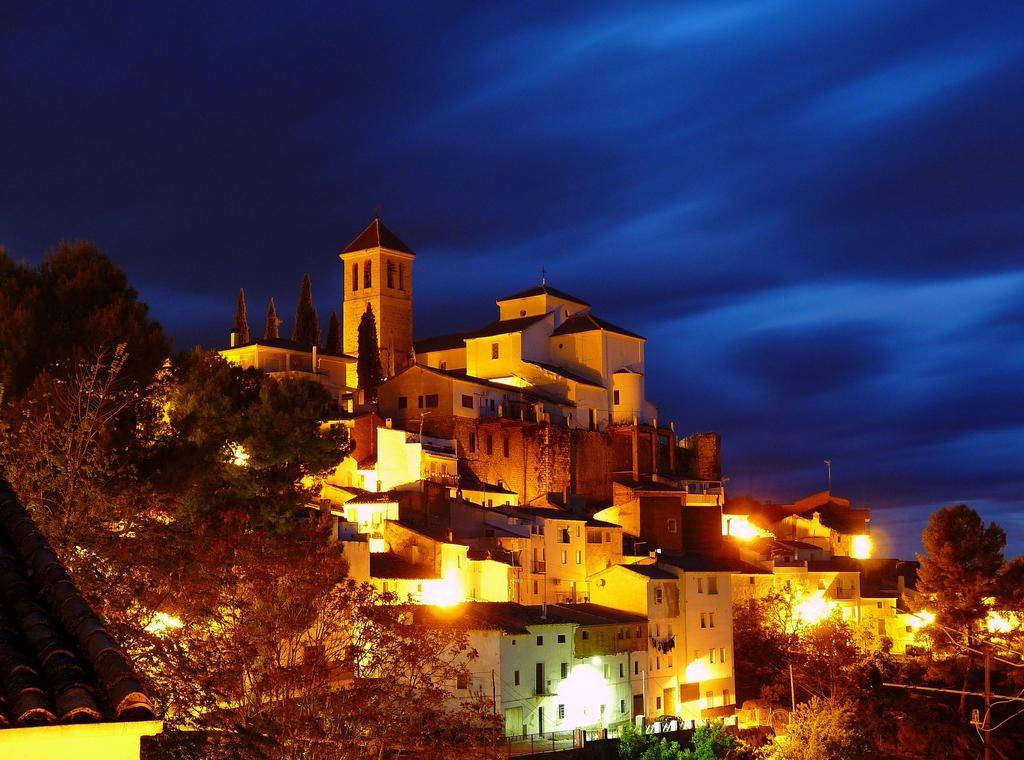
Cazorla Rural, Quesada
Cazorla Rural combines a self-catering setup with an outdoor pool, hot tub and mountain and city views in Quesada. Its kitchen and outdoor dining area support an independent stay, while the town’s…
Read hotel guideThe art of finding somewhere wonderful.
Video by Nirjhar Basak on Pexels
Quesada’s history is visible both in the fabric of its old streets and in archaeological remains scattered across its municipality. In the historic centre, surviving stretches of the medieval defences trace a route through streets including El Cinto, Alcázar and Alcaldía, and around the Paseo de Santa María, Mirador de Camilo José Cela and Plaza de la Lonja. The remains are fragmentary, but together they suggest how the settlement followed the contours of its hill: narrow streets and closely gathered buildings within and around the former walled enclosure.
The Arco de los Santos offers a particularly tangible encounter with that past. This pointed Gothic gate formed part of the fourteenth-century wall and still marks an entrance towards the old town. Its carefully cut stonework includes a Roman funerary stele in one jamb, dedicated to the priestess Caia Rufina by her son. Beyond the arch, the historic streets lead towards the Church of San Pedro y San Pablo, whose three-nave interior and oval vault over the crossing reflect an eighteenth-century design. Its exterior has been altered, making the contrast between the church’s restrained outward appearance and its more elaborate interior especially notable.
Quesada’s past extends well beyond its historic centre. At the Villa romana del Bruñel, on a low rise south of the Arroyo de Bruñel, remains record occupation from the second to the fourth centuries AD. The complex includes the plan of a substantial villa, with an atrium and impluvium and a peristyle around which many of its rooms were arranged. Mosaics and painted stucco add detail to the archaeological story, while earlier remains point to a late Iberian phase before the Roman occupation.
Other evidence belongs to a much older landscape of settlement and symbolism. Rock shelters in the municipality preserve prehistoric paintings and engravings, among them the Cueva del Encajero, with schematic figures in red, and the Cuevas de Cerro Vítar, whose painted motifs include crosses, bars and a Y-shaped figure. These works are fragile and, in some cases, poorly preserved; their significance lies in the rare traces they offer of lives and images from a distant past, rather than in any promise of a readily legible display.
For a different view of Quesada’s medieval setting, the remains of the Castillo de Majuela stand on a small strategic spur above olive-growing land. The surviving towers and fortifications evoke a defensive landscape around the settlement. Taken together, these places make Quesada more than a town with a historic centre: its story unfolds from medieval gateways and church architecture to Roman domestic life and prehistoric art, each part rooted in a different corner of the municipality.
Cazorla Rural combines a self-catering setup with an outdoor pool, hot tub and mountain and city views in Quesada. Its kitchen and outdoor dining area support an independent stay, while the town’s…
Read hotel guide