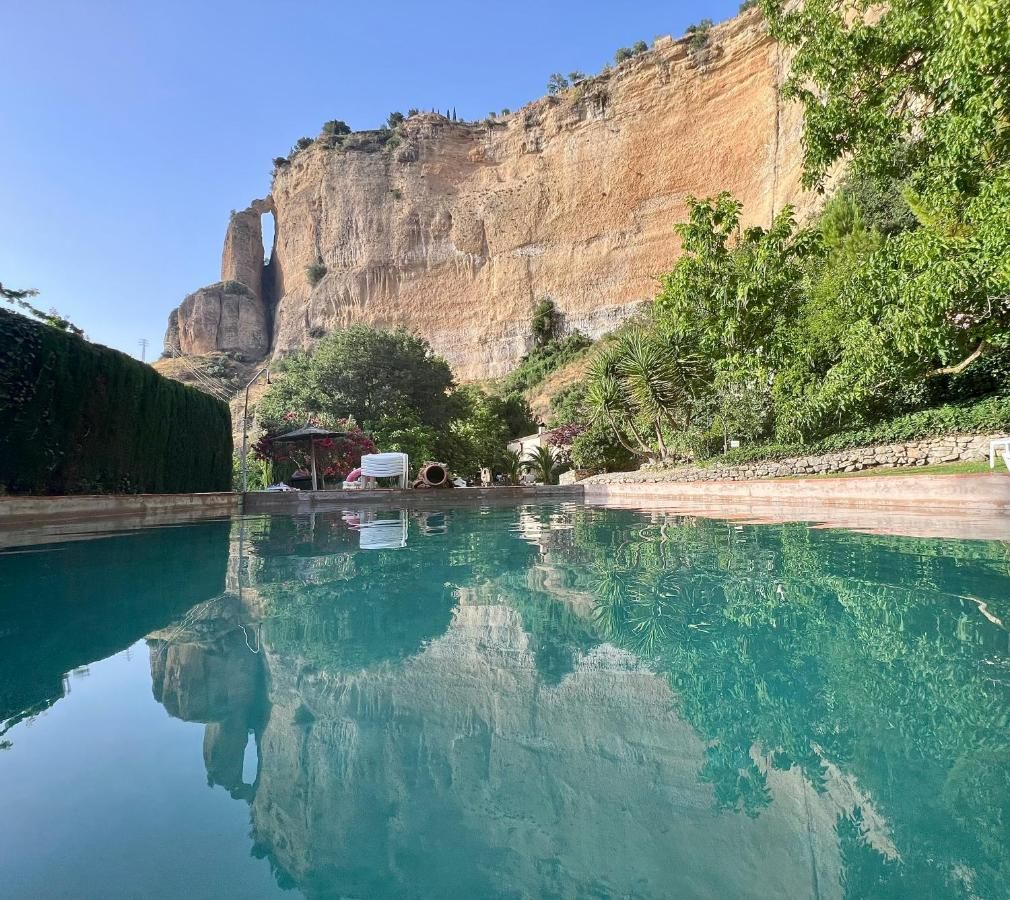
Ronda’s old town is shaped by a dramatic cleft: the river Guadalevín runs through the Tajo, dividing the high settlement into distinct parts. The town’s street plan reflects that layered setting. La Ciudad retains the complexity of its Arab-era layout, while the older streets of the Mercadillo follow routes towards the bridges. Across the historic centre, the urban fabric records successive periods of change rather than a single, uniform plan.
Three quarters, many layers
The historic town is structured around La Ciudad, the Mercadillo and the Barrio de San Francisco. La Ciudad follows the intricate pattern of the former Muslim medina, though later changes altered some lanes and street alignments. San Francisco developed outside the walls; its fan-shaped streets converge on the Almocábar gate, with straighter lines reflecting later growth in the seventeenth and eighteenth centuries. The Mercadillo, meanwhile, has its own older, irregular streets shaped by routes towards the crossings.
That history is visible in buildings as well as in the street plan. The Casa del Gigante began as a domestic building, probably in the fourteenth century, and retains elements associated with its Muslim origins. Its rooms and courtyards reflect later alterations, while a surviving, much-weathered stone relief helps explain its name. At the Casa de Mondragón, three courtyards bring together Gothic, Renaissance and Mudéjar features; the building’s evolving form makes architectural change part of its character.
Water, walls and civic life
Ronda’s relationship with water is especially clear at the Arab baths in the lower part of the town. Built in the thirteenth or fourteenth century, they were supplied from the Guadalevín by a water-raising wheel and a small aqueduct. Although their surface decoration has been lost, much of the hydraulic system remains, offering a sense of how the baths functioned. The site also preserves traces of later leather-working, after the baths ceased to be used for their original purpose.
The town’s defences follow the edge of the high plateau and its rocky slopes. The surviving urban walls belong to several sectors and periods, including the medina defences and the walled district around Almocábar. Elsewhere, Ronda’s public architecture takes a different form: the eighteenth-century bullring is circular, with superimposed galleries and stone entrances, a carefully composed counterpart to the older, irregular streets.
Ronda is best understood through these contrasts: a settlement shaped by a gorge and river, but also by the quieter intricacies of courtyards, lanes, waterworks and walls. Its historic centre is not one monument in isolation, but a meeting of urban forms and architectural inheritances.