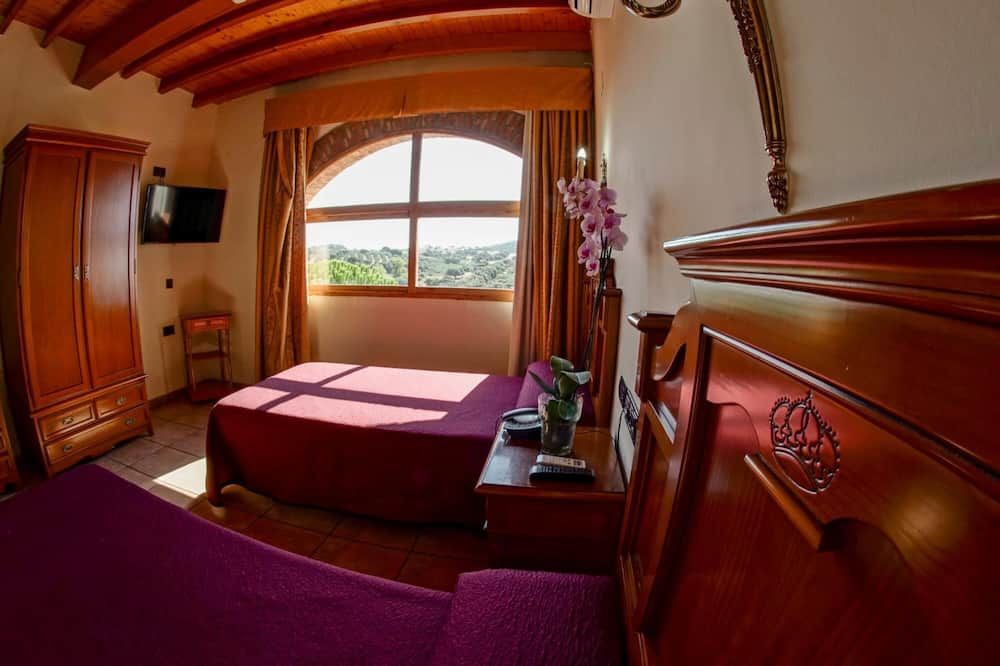
Hotel Alfonso VIII, Santa Elena
Hotel Alfonso VIII pairs free parking and 24-hour reception with a restaurant, bar and hot tub on the Autovía de Andalucía at Santa Elena. Its full-service facilities suit a road stop or…
Read hotel guideThe art of finding somewhere wonderful.
Video by Nirjhar Basak on Pexels
Santa Elena occupies a revealing threshold in northern Andalucía. Its setting in the foothills of Sierra Morena, beside the entrance to the Despeñaperros pass, has long made this a place of passage between the Guadalquivir valley and the central plateau. The landscape is more than a backdrop: ridges and narrow, deeply cut valleys shape the approaches, while the town itself sits on a gentle south-east-facing slope below Cerro del Justo.
The historic core is concentrated around the Plaza de la Iglesia. Here, the street pattern is broadly orthogonal, though neither perfectly symmetrical nor continuous. Wide, straight streets and, in places, tree-lined pavements give the centre a measured character. Much of its modest domestic architecture follows a consistent pattern of one- or two-storey houses, preserving a recognisable townscape even where individual façades have changed.
The Iglesia de Santa Elena gives the square its defining landmark. Built in the second half of the eighteenth century, it has a notably restrained exterior: a central semicircular entrance reached by steps, simple pilasters and a straight pediment, with an espadaña rising above. Inside, the single nave is covered by a barrel vault with lunettes; a transverse arch marks the transition to the chancel, whose vault is ribbed. The contrast between the plain façade and the more articulated interior rewards attention to the building’s details rather than its scale.
Santa Elena’s position near Despeñaperros is also written into its heritage. The ruins of Castro Ferral, an Andalusi watchtower associated with the period of the battle of Las Navas de Tolosa in 1212, occupied a commanding position guarding the historic route through the mountains. The account attached to the site recalls the struggle to cross the Sierra Morena and the passage by Puerto del Rey and Salto del Fraile. It is a reminder that this rugged corridor was not simply a line on a map, but terrain with strategic importance.
Older still are the traces around Collado de los Jardines, where an Iberian settlement and sanctuary are documented amid the steep relief of the Sierra Morena. Nearby rock shelters preserve schematic painted figures in red, dark brown and other colours. Their subjects include human forms, animals and geometric marks; at Cueva del Santo I, two seminaturalistic goats appear among a larger body of paintings. These fragile remains connect the area’s rocky landscape with long-standing human activity, though their condition is recorded as poor and they should be treated as heritage to protect, not casually approached.
On a different scale, the Osborne bull installed on a hill in 1965 turns a familiar advertising image into a striking landmark. Together, these places give Santa Elena a character shaped by passage and persistence: a compact town at a mountain gateway, with its own carefully legible centre and a surrounding landscape layered with history.
Hotel Alfonso VIII pairs free parking and 24-hour reception with a restaurant, bar and hot tub on the Autovía de Andalucía at Santa Elena. Its full-service facilities suit a road stop or…
Read hotel guide