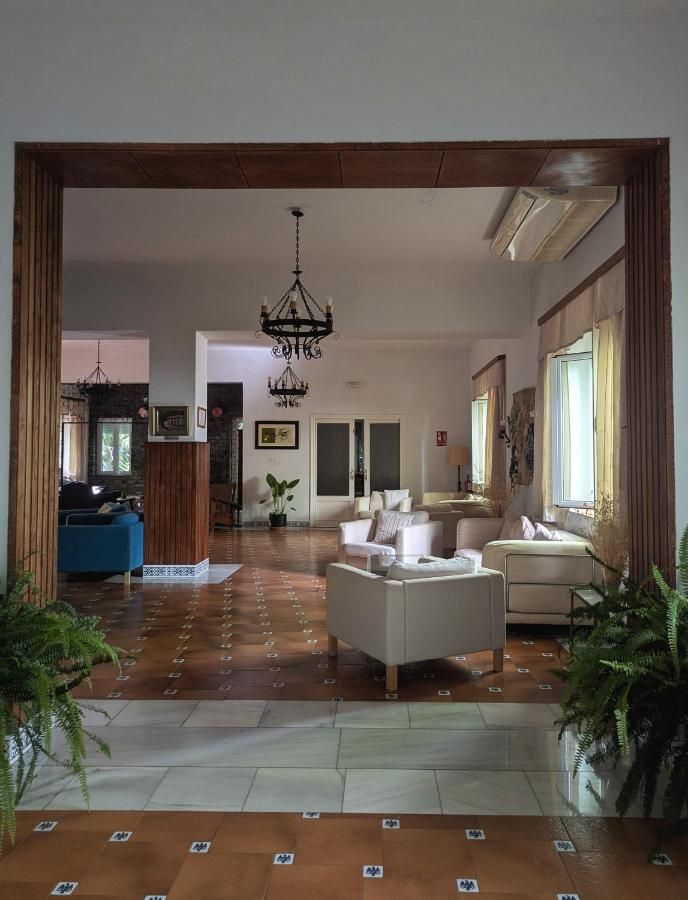
Hotel Del Balneario, Tolox
Hotel Del Balneario pairs an outdoor pool, garden and restaurant with family rooms and notable accessibility features in Tolox. Its setting connects a practical hotel stay with a town known for mineral…
Read hotel guideThe art of finding somewhere wonderful.
Video by Nirjhar Basak on Pexels
Tolox’s story comes into focus through two very different kinds of landmark: the remains of a medieval fortress and a spa whose reputation rests on local springs. Together with the parish church and the hilltop setting of the Ermita de San Roque, they give this town a character shaped by both long-held traditions and the buildings that have carried them forward.
The Balneario de Fuente Amargosa grew from springs known locally as “amargosas”, a name linked to their distinctive taste. Residents had long used the waters in baths and as a drink for a range of ailments. A small spa establishment opened in 1869, and the waters were declared of public utility in 1871. After a flood destroyed the original building in 1906, it was rebuilt by Manuel del Río.
The present building has a strikingly formal design. Its ground floor is rectangular, while the upper storey forms a U, with small projecting pavilions at either end. Two staircases meet a balcony within the open centre; the composition is symmetrical, with glazed semicircular-arched openings and a green roof of glazed tiles. The spa stands in a setting described as part of the Serranía de Ronda, in the Sierra de las Nieves and near the pinsapar. Its history connects the town’s local knowledge of water with a place that, from the late nineteenth century, attracted visitors including politicians, artists and bullfighters.
The Iglesia de San Miguel Arcángel has a more layered architectural history. Although its construction is recorded as completed in 1505, the church was badly affected by fire during the Morisco uprising of 1568. It was rebuilt in 1577 under Diego de Vergara, master builder of Málaga Cathedral, and required further restoration in 1632. Inside, three irregular naves are divided by arches on square pillars, while the central nave has a timber roof and the main chapel an elliptical painted vault. Its successive repairs are part of the building’s story, not merely interruptions to it.
Only a fragment of Tolox’s old castle survives: a stretch of wall and a passage, with the former fortress largely gone by the end of the fifteenth century. Its origins are attributed to the Phoenicians; the Romans are also said to have used it, before Omar Ben Hafsun occupied and rebuilt it in 883. The neighbourhood of Rinconada del Castillo developed on the former site, where the remains offer a modest but tangible link to the town’s earlier defences.
For a different perspective, the Ermita de San Roque stands at Atalaya, about two kilometres from the town. Built in the 1980s over the remains of an earlier hermitage, it is a simple white building with a stone base and an iron cross above its steps. The setting looks towards both the Sierra de las Nieves and the Río Grande valley. In the first half of August, a pilgrimage carries the patron’s image from the town church to the chapel before the San Roque fair. Tolox’s landmarks thus range from carefully rebuilt interiors to a local procession, each revealing a different way the town has kept its history present.
Hotel Del Balneario pairs an outdoor pool, garden and restaurant with family rooms and notable accessibility features in Tolox. Its setting connects a practical hotel stay with a town known for mineral…
Read hotel guide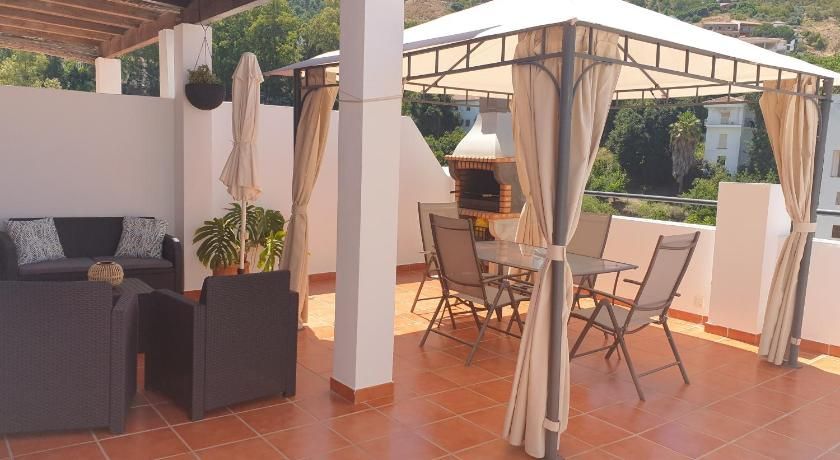
Riu Tolox pairs a private pool and mountain views with the facilities for self-catering, from a full kitchen to outdoor dining. Family-friendly touches and a fireplace make this an independent base for…
Read hotel guide