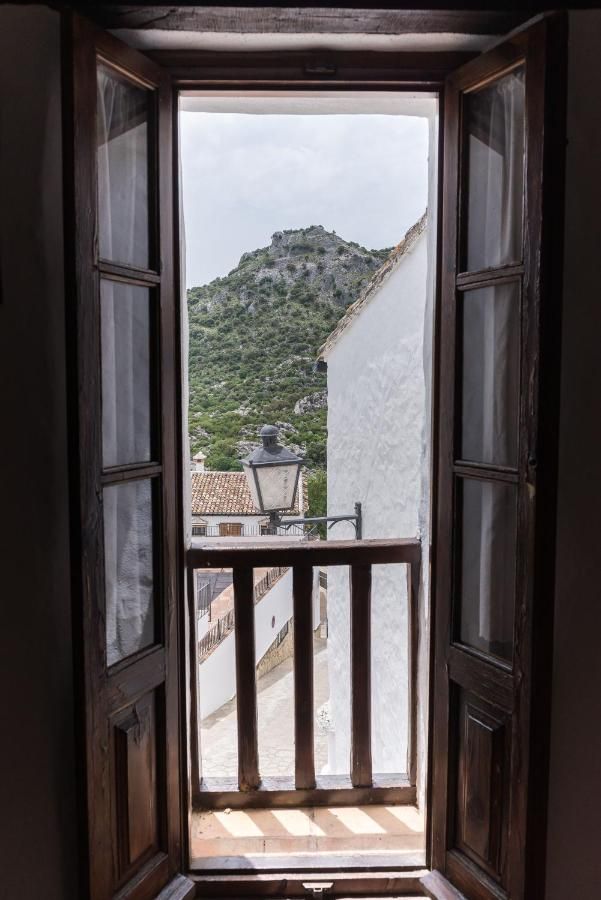
Villaluenga del Rosario is best understood through the close relationship between its mountain setting, its water and the traces left by generations of settlement. The Sierra del Caíllo frames a landscape of limestone and caves, while the town’s heritage records tell a more intimate story: how people drew on local resources, shaped communal spaces and marked the rhythms of religious and social life.
Stone, caves and deep time
In the Sierra del Caíllo, the Cueva de las Palomas belongs to a group of closely neighbouring cavities. Finds recorded there include stone tools and pottery, alongside geometric rock engravings and a depiction of a deer’s head dating to the Upper Palaeolithic. These remains place human activity in the area within a very long perspective, although the cave’s archaeological significance should not be mistaken for a promise of public access.
Another chapter lies at El Chaparral, where fossil remains of macrofauna and microfauna have been dated to more than a million years ago. The find, made in 2009 in a deposit of calcareous breccia, was assessed by specialists and followed by an archaeological and palaeontological investigation. Together, these sites make the municipality’s story reach far beyond its streets, into a landscape whose record spans both human prehistory and a much earlier natural past.
Water and the built town
The Acueducto de Villaluenga offers a different way to read the terrain. Its qanat runs for about a kilometre from the slopes of Sierra Peralto, following a course parallel to the Arroyo Albarraín before reaching the settlement and the public fountain known as the aqueduct’s terminal fountain. In its final stretch, the channel rises on masonry to cross uneven limestone ground. Four large wells and sixteen smaller inspection openings are among the visible features described in the heritage record; three of the larger wells have octagonal brick structures capped by distinctive vaults.
Water also shaped shared, practical places. El Pozo del Prado formed part of the local supply network and served as a watering place; it remains an alternative water point used principally by local farmers and livestock keepers. Such structures bring the working history of the municipality into view, alongside more monumental landmarks.
In the town, the Plaza de Toros is notable for its stone construction and for the rock that emerges through parts of the arena. Built in 1965 to replace earlier temporary structures on the same site, it has an unusual arrangement without a lane around the ring. The Iglesia de San Miguel and the small Ermita de San Gregorio add another dimension to the local architectural story: the latter dates to 1703 and is associated with the annual departure of the Romería de la Divina Pastora.
Villaluenga’s appeal lies in these connections rather than in a single headline sight: limestone country and archaeological traces, carefully managed water, and buildings that preserve both public ceremony and everyday use. Read together, they offer a grounded sense of a mountain municipality shaped by its landscape and by the ways its inhabitants have lived within it.